Make sure you don't have retention backwards.
Your first ten users already know.
This is not a rehash of old content or something to waste your time. Ever since this topic came up, it's been an on and off discussion between us.
If you missed it, about three weeks back there was this tweet going around asking founders if they cared more about acquisition or retention. Now we all know it's part engagement farming, part grandstanding, but it's also totally relevant.
The replies were split roughly how you'd expect it, with most saying retention, but with early stage founders choosing acquisition. Retention was seen as a later problem, something you earn the right to worry about once there's traction and you actually have someone to retain.
I understand the logic, but Ross had an interesting take. It goes hand in hand with the revenue discussion they had last week with Ilya
His point was about who those first users are to you.
They're the ones who gave you your first shot and tried your product when there was nothing backing it. No track record, no social proof, no friend who recommended it, just your vision and the promise you made.
They took a leap of faith on you and that makes them the purest signal you'll ever get about whether the product actually works.
If these people aren't sticking around and inviting their friends, then this is a major red flag and you need to get on that ASAP because every new user you pull in is running into this.
The problem will be in the product, customer service, or worst of all, both.
Another thing Ross is right about: unless you're at literally zero, retention is already in play. Once you have any users at all, part of the job is keeping them.
The reason this jumped back to mind was we were discussing it this week and he brought up the leaky-bucket scenario.
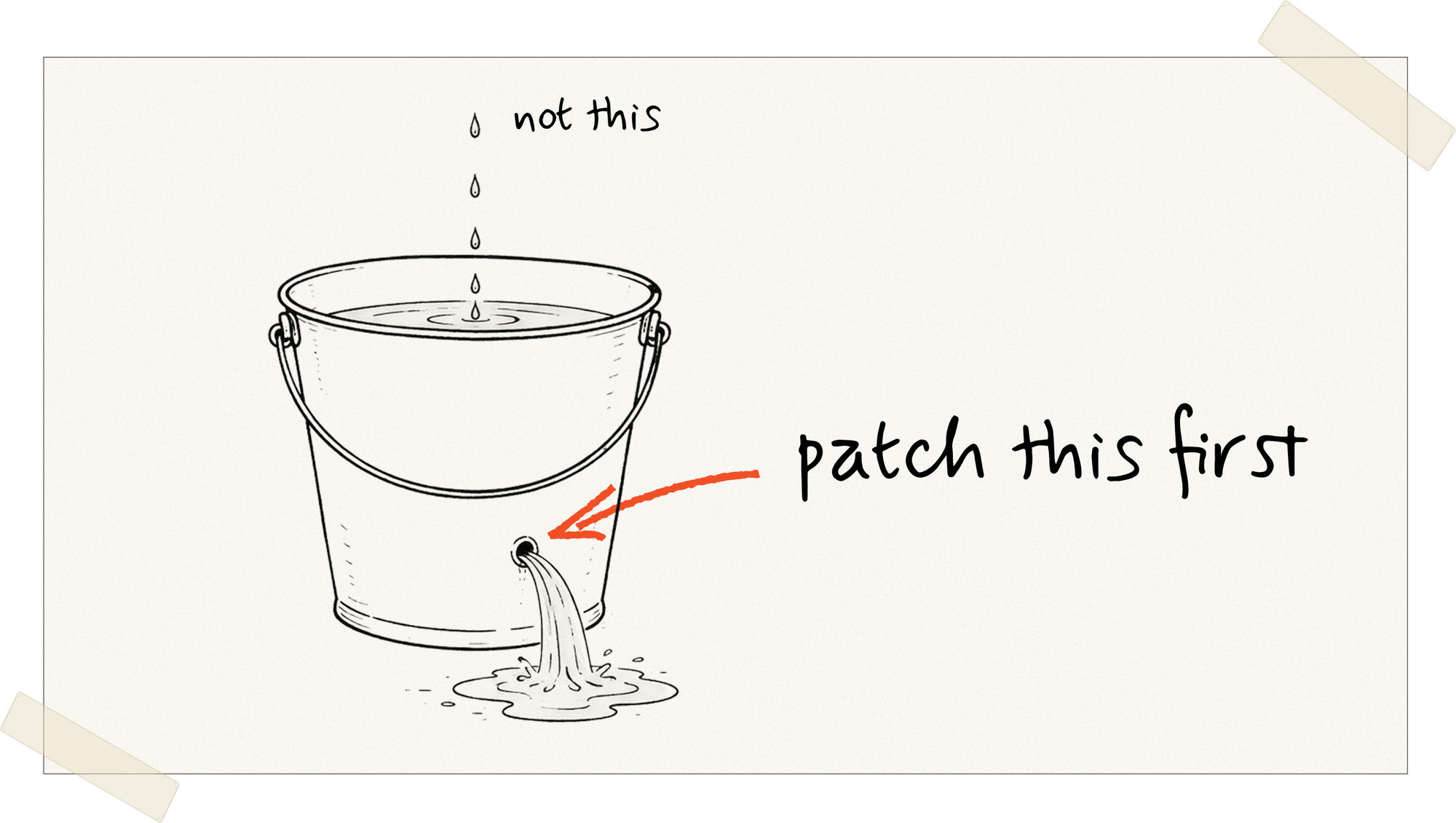
There's probably a version of this for every discipline, but the gist is you're holding a bucket. Water is dripping in from the top and pouring out a hole on the side. What's your first move? You patch the hole, of course. Pouring water in faster doesn't fill a leaking bucket, it just spills more. Then you try to get back what you can of the spilled water. And only then, you worry about increasing the drips.
So the order is - product first, reactivation second, new users third. Not that you do them one at a time, early on you're pouring the whole time and you have to. It's about what you tackle when the bucket won't fill.
Product first means patching the hole where it actually is: you have to deliver the value you promised, and when it falls short, if you're lucky, you'll hear about it and then you fix it fast. Customer service is also part of this and the perfect place for you to bake in a feedback loop to make sure you get the right information from the right user. Be careful not to fall into traps where you listen to the wrong users about the wrong things.
Reactivation is bringing back the people who've used your product, but drifted. Who a genuine "here's what we fixed" or "here's how we have grown" message can bring back. Over the course of the 50-plus campaigns we've run, returning users are absolutely invaluable in terms of LTV and also easily become the happy ones who'd refer a friend.
Finally, there's new users, the marketing and awareness work, going beyond the people who already know you exist. Do it on top of the first two steps though, not instead of them. It's a lot easier to bring people to something that already works and hold onto the ones it wins over.
If you're early stage, of course you should be seeing new users as the core of your numbers. You've got no dormant users to reactivate and no base to compound. But as you're onboarding them, make sure your product or service is at minimum meeting expectations. As you grow and get the right feedback, you work towards exceeding them, but make the foundation strong first before you scale.
Another thing to keep in mind is today's new users are tomorrow's returning ones.
So you keep acquiring, but what changes is the job you give the data on those users.
How long do they stay? Does their volume grow, or do they touch the product once and vanish? Do they come back without being paid to?
Those answers are available from your first ten users onwards, and they're the verdict on whether you've built something sustainable or just something people try and then move on.
I remember Ross said something near the end of that call that ties it together.
The goal of marketing is market share. If users are leaving faster than they're arriving, you're losing share, and it doesn't matter how good the top of the funnel looks while it happens.
In web3 that's so much harsher, because the pool of users is small, everything's interoperable, and leaving your product is as easy as using a different one next time.
Nothing locks anyone in here. The product and your service has to do the keeping.
So, next time you see that engagement farming acquisition-or-retention question, remember that in reality it's basically both of them, and at the same time, with acquisition getting a slight head start.
And acquisition are the users you're getting right now and retention is how you find out if everything is working as planned and users are happy.
So in three months, check to see if the people who believed in you first are still here?
Was this forwarded to you? Subscribe free to get the next article in your inbox.
Wayne Hattingh — Always learning, never bored. Partnerships @TICC