Do you know what stays after the incentives stop?
We couldn't get solid numbers on the users KOLs bring, so we took apart the paid growth we could check: grants, rewards and points.
This week's a bit of a long one.
There were a lot of posts on X (formerly Twitter) this week about KOLs, and what they bring a project when you use them to onboard new users.
KOLs is an on-again-off-again discussion amongst us, so I figured I'd do some research and see what data is out there on what's left once the KOL gets paid and moves on.
The best study we found only measures the token price. Researchers at Indiana and Harvard looked at about 36,000 tweets from 180 big crypto influencers, covering more than 1,600 tokens. On average, tokens were up 1.83% on the first day, and down about 19% after three months.
That’s token price data through the end of 2022. It doesn’t track users, so it can’t say much about what a project got for its money.
On whether those users stick around, we couldn’t find anything independent.
Most of what’s out there comes from firms selling KOL campaigns (or selling an alternative).
What we could dig into was the same question in areas with public data: grants, rewards, and points.
Paid growth, and what stayed after the money stopped.
Two cases keep getting passed around as proof that incentives can stick, 40acres in Optimism Season 8, and Compound's USDT pool from Arbitrum's LTIPP.
We read the reviews behind them. What we found is narrower than the headlines, but it's more useful.
The cases people point to
Optimism's Season 8 Growth Grants put 2.21M OP across nine programs. Brichis, a former Grants Council member, wrote a TVL impact review, and found that 40acres alone supplied 84% of the net change in TVL.
The numbers read well. 200k OP in, about $6.76M of fixed-price TVL growth, and 109% retention 30 days later. It was also the fastest in the group to launch.
Compound's USDT pool on Arbitrum is the other one.
Compound launched the pool with ARB incentives during LTIPP, which ran from 1 June to 31 August 2024. Across Compound on Arbitrum, supply went from roughly $90M to $260M, and USDT reached about 30% of deposits at peak. The Arbitrum assessment called it clear product-led success.
On paper, both look like paid growth that stayed.
Then you change how you measure
Brichis also published the underlying numbers. and they show how much the headline depends on how you count.
At one fixed token price, 40acres added +$6.76M. In plain dollars, the same contracts over the same dates fell -$7.4M.
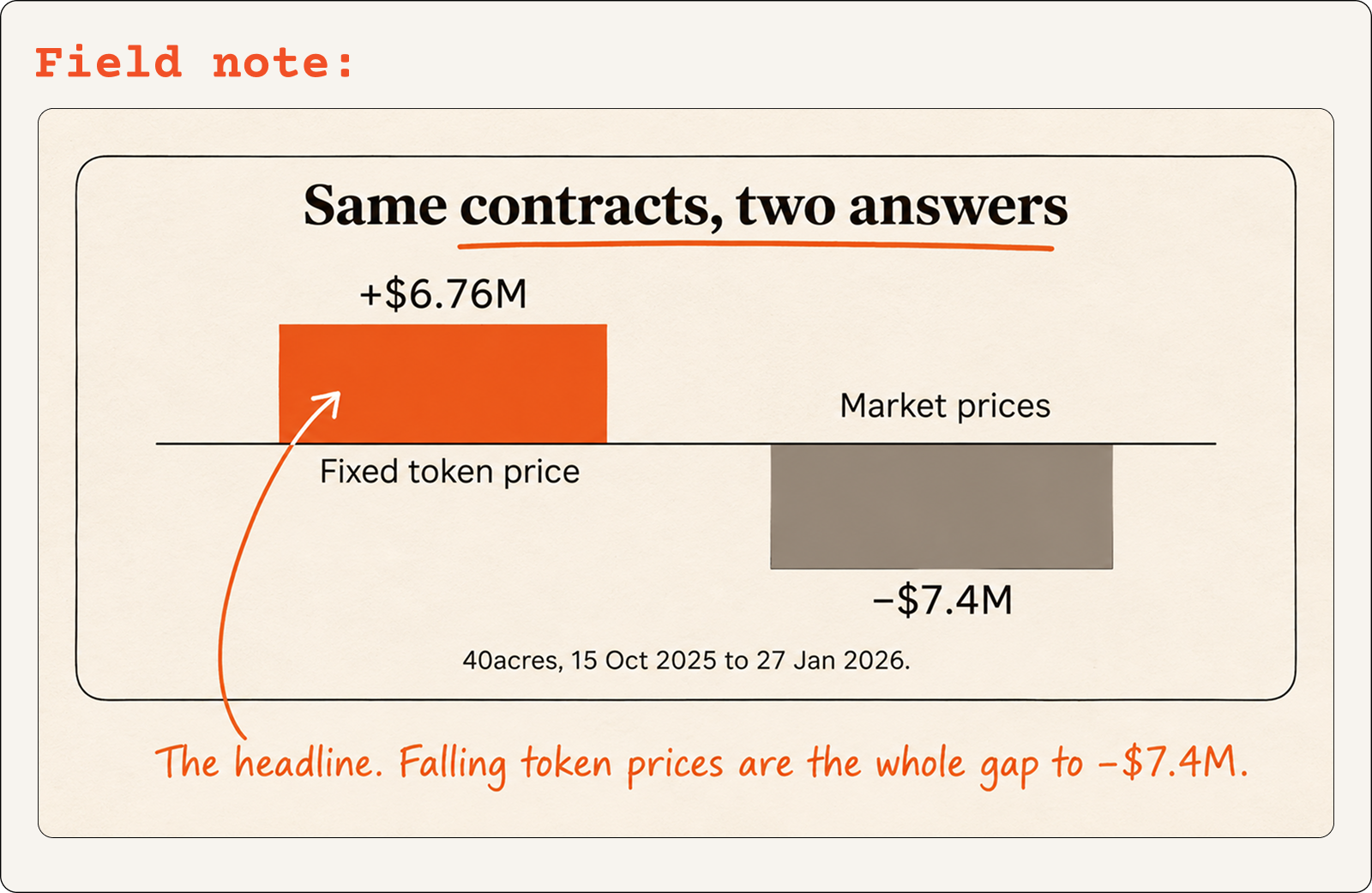
Both are true. People kept adding deposits, and token prices fell. Fixed price hides the fall. Market price hides the deposits.
Neither number tells you what stayed, so we looked at the contracts one by one.
Most of the growth wasn't on Optimism. About 94% of the result from an Optimism grant landed on Base.
A lot of it was also locked. Users deposit Velodrome or Aerodrome veNFTs and borrow USDC, and the debt repays itself from the veNFT's rewards over months or years. That collateral isn't going anywhere soon, and on a dashboard, lock-in looks just like stickiness.
So we split the two apart for the thirty days after the rewards ended.
The money that could leave whenever it wanted mostly stayed. The locked side kept growing, with new deposits that lock-in doesn't explain.
So 40acres holds up better than the dollar number suggests. It's also less of an Optimism win than the headline suggests. You only see that once you split the contracts apart.
Compound has its own caveats.
The two reports people cite aren't two separate opinions. Castle Labs wrote the retention study, and also co-wrote the Arbitrum assessment with DefiLlama Research. The strongest "it stayed" claims come from that one group and from AlphaGrowth, Compound's growth contractor, which ran the campaign.
So we read the pool's contract ourselves.
Deposits did leave. USDT supplied roughly halved between August and October 2024, then recovered to about two-thirds of its August level by January.
Borrowing didn't leave. It never fell below its August level, and by January about 90% of the USDT in the pool was being borrowed. The deposits that left were the ones nobody was using.
The measurement window is short almost everywhere too. The ARDC/Blockworks STIP deliverables checked spot DEX "persistence" about two weeks after the program ended.
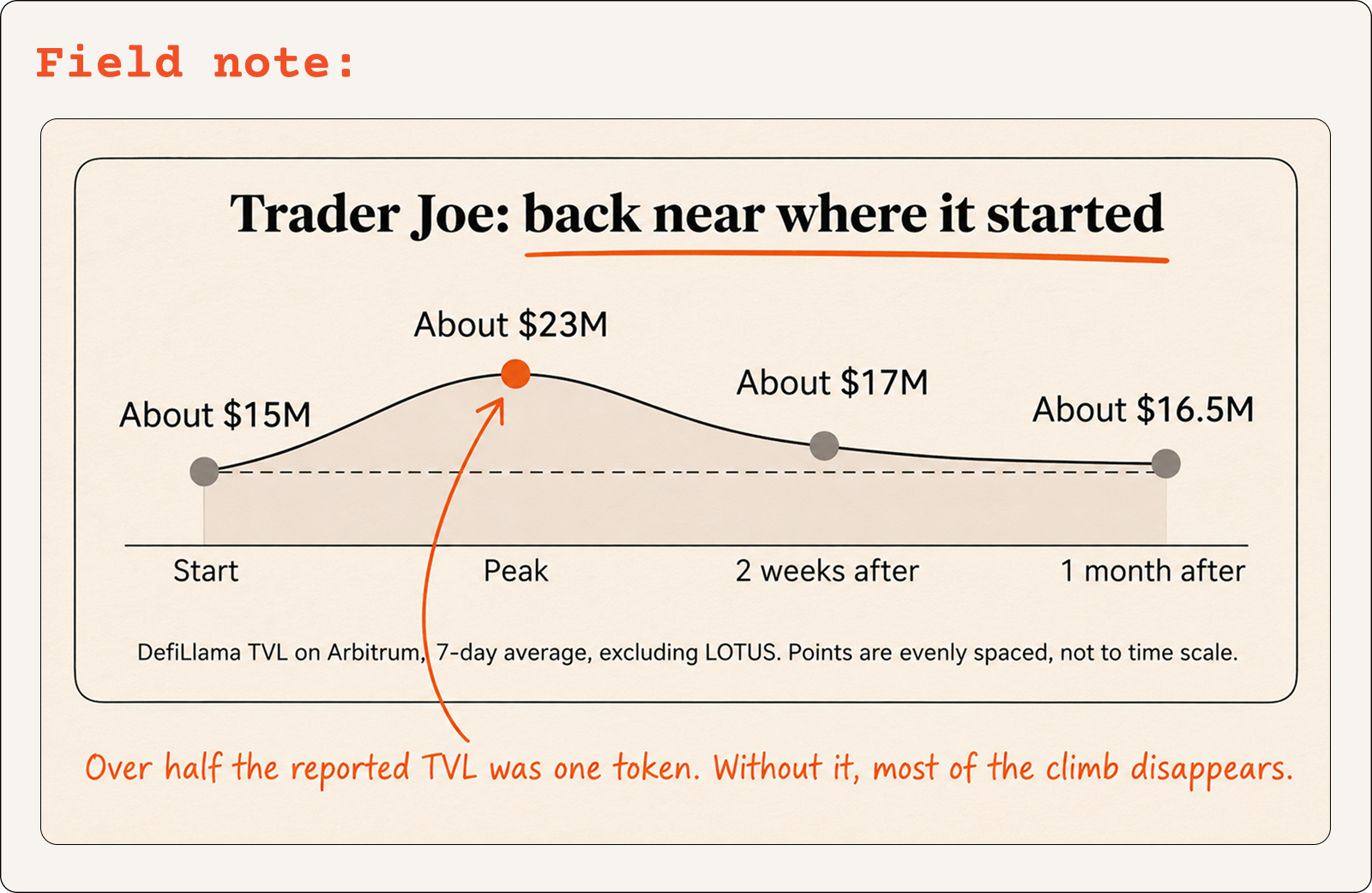
On those numbers, Trader Joe looks like it held. TVL went from $27.5M at the start to nearly $50M at peak, and two weeks after the program it was still at $37.5M.
DefiLlama's token breakdown shows what was inside that number. More than half of the peak was one token, LOTUS. About 90% of its supply had been sitting in a single Trader Joe pool since months before the program, at the same price in ETH. When ETH doubled, so did its dollar value, and that alone added about $14M.
Take LOTUS out, and remove the effect of other token prices, and there's almost no growth left to retain. The liquidity stayed close to where it started for most of the program, then fell. Two weeks after the program ended, it was about 17% below where it began.
It's the 40acres problem in reverse. There, market prices hid deposits that were arriving. Here, they hid liquidity that wasn't.
What survives
Across the write-ups, a few things keep showing up.
Fees that replace the subsidy.
Gauntlet compared five Uniswap pools on Optimism with similar pools, and two kept a lift after the rewards ended, at least for the few weeks their data covers.
In one of them, wstETH/WETH, Gauntlet's explanation is that more liquidity brought more trading, and the fees from that trading gave liquidity providers a reason to stay. That pool had been almost empty, and it ended well below its peak but above where it started.
Gauntlet sells incentive design, so read them with that in mind. Comparing against similar pools is still one of the cleaner methods we've seen.
Opening a market that was empty or new.
The Arbitrum assessment says the clearest exceptions came from protocols launching new products or entering new markets. Rewards spent where Arbitrum already had a stable share mostly didn't stick.
Compound's USDT pool fits here. It started empty, and people kept borrowing after the program ended.
Rewards that reached people who already needed the product.
About 80% of 40acres' result was locked Velodrome and Aerodrome tokens, so it came from people already invested in those projects. Most of Compound's deposits came from wallets that had deposited before.
We've said this to every single project we work with: reactivation and returning users are where the true value lies for most projects.
New users do count, but it takes time for them to become valuable users. It could be a trust factor in crypto, but that's purely a thumb suck.
More time didn't help either.
Brichis again: "The extra weeks bought decay, not liquidity." Across the nine Season 8 programs, the typical one peaked around week eight, and longer programs didn't peak later.
The Arbitrum assessment thinks its three-month programs were too short, but it's clear that extending a program isn't a fix on its own.
Hyperliquid often gets named as the counterexample. But the retention numbers that go around come from Myshteri, whose trading firm invests in Hyperliquid infrastructure. We haven't seen independent data that matches. It's worth watching, but it's not something to lean on yet.
We ran our own version of this
We have a more ordinary case at home.
Outposts is our digest product. It lets users totally customize and design their own newsletter.
From April 2024 to April 2025 we ran Lightyears, a points program that paid readers for engaging with digests.
This is the timeline, from our own public posts.
- 19 April 2024: Lightyears points went live, for reading digests, clicking articles and referrals.
- May to June 2024 (Season 1): paid in $DEGEN. Referrals paid the most, 2,500 points against 1,000 for a read or a click.
- August to September 2024: Season 2 paid out $5,000 USDC. We switched from $DEGEN to stables.
- Later seasons also paid out $5k USDC each, same format as season 2.
- 3 April 2025: we ended the monthly rewards pool, citing market conditions, technical problems and tax complications.
We can't give you open rates from before and after. Tracking opens was getting the digests flagged as spam and blocking delivery, so we stopped tracking them right after the rewards ended.
What we can see is engagement on the Outposts Farcaster account's own casts, counted as they stand today.
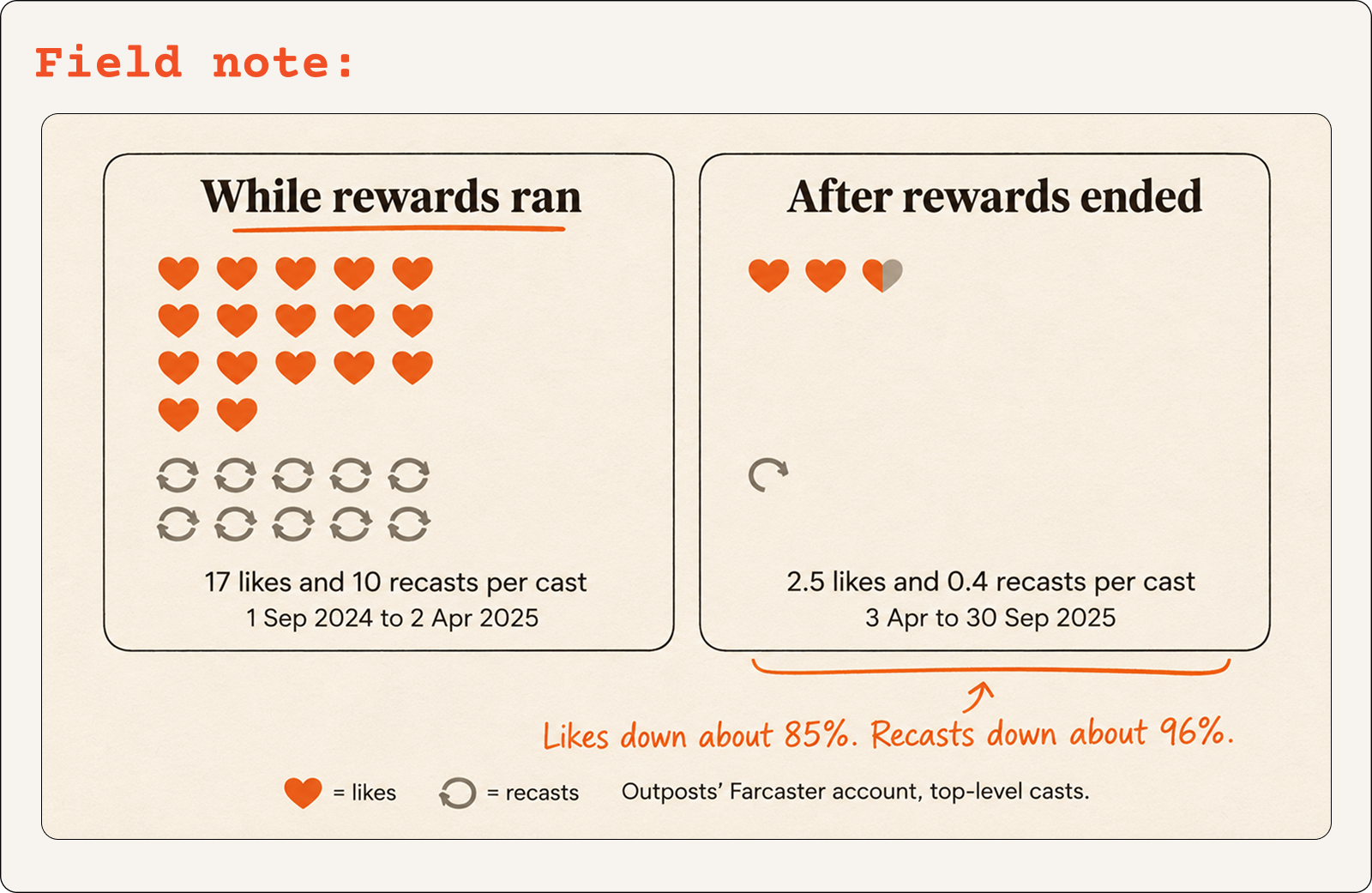
From 1 September 2024 through 2 April 2025, we got about 17 likes and 10 recasts per top-level cast. From 3 April through 30 September 2025, at similar cast volume, we got about 2.5 likes and 0.4 recasts.
Likes per cast fell roughly 85%, and recasts about 96%.
A lot of the engagement before April sat on claim and digest frames that users had a reward reason to touch.
Farcaster itself was also losing activity over much of this stretch, and we have no comparison group here. So this shows engagement tied to rewards dropping, but it isn't a clean measure of readership.
Paying people to open digests was expensive, and when we stopped, it looks like a large share of that activity left.
That part was definitely rented.
Outposts is still one of the main advertising channels on our network.
It kept working after we stopped paying people to open it.
What's remained was the distribution we'd earned from the readers who wanted the digests.
That's what the numbers look like from inside.
Before the next dollar goes out
If you're about to spend on incentives, grants or points, the useful moves come down to the basics, and they need to come early before anything else.
Decide the measurement before the money leaves.
Baseline the contracts. Pick whether you'll report at fixed token prices, at a snapshot date, or in plain USD, and stick to it, because the method can flip the sign.
Then decide how long after the program ends you'll look.
Two weeks will flatter almost anything. Thirty days is a start. Ninety is better.
The same goes for your next KOL deal. Decide how you'll measure it before the money leaves.
The Arbitrum assessment's note on deliberately tapering rewards to see whether usage holds is one of the few practical tests.
Pump.fun ending its 4x referral boost this month is a live assessment of the same kind. The boost is now gone and anyone watching can see what the boost was buying.
If crypto is going to be a viable business option for more than a handful of fee-taking apps, the growth systems around it have to tell you what stuck once the subsidy ended.
Spending can still be the right move.
The job is knowing which part of the spend rents activity, and which part lands on a product people already need.
Was this forwarded to you? Subscribe free to get the next article in your inbox.
Madusha Thilakarathna — Co-founder @ TICC. Building Specify, Outposts, Maru and W3A. Website